Basic Concepts
Human beings understand the world by grouping things into particular categories or classes, but these classes are not independent of each other; instead, they are organized into a hierarchy.
For example, we organize our knowledge about the animal kingdom in a hierarchical fashion using classes like these:
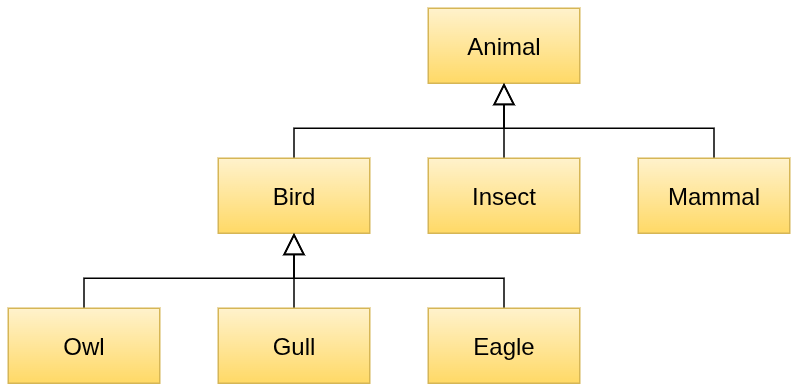
On this diagram, the most general class, Animal, is at the top, at the
root of an ‘inverted tree’. As we moved downwards, classes become more
specialized. Those at the bottom (the leaves of the tree) are the most
specialized of all.
Consider two specific classes from this diagram: Bird and Owl.
We say that Bird is the superclass of Owl, and that Owl is a
subclass of Bird1.
We can also say that Owl ‘specializes’ Bird. The relationship between
the two classes is one of specialization. In practice, this means that
Owl inherits things from Bird, so we can also describe the relationship
using the term inheritance. We will use that term here2.
This hierarchical organization of classes is very useful. For one thing, it facilitates more efficient communication. Imagine, for instance, that you were familiar with the concept of birds in general, but you didn’t know what an owl was. Someone could painstakingly describe to you an owl’s feathers, the fact that it has wings and can fly, etc; or they could just tell you “a bird is a kind of owl”. That simple phrase would instantly reveal the most important things to know about owls.
Inheritance in Software Classes
A class hierarchy in the real world helps us to organize and communicate information more efficiently, and we can glean analogous benefits from organizing software classes into inheritance hierarchies.
In such a hierarchy, a subclass inherits the attributes and behaviour of its superclass, so inheritance provides a structured mechanism for code reuse. Instead of having code duplicated across multiple classes, that code can be provided once only, in a superclass from which they all inherit.
Besides inheriting code from a superclass, a subclass can
-
Add new attributes and behaviour that aren’t found in the superclass
-
Alter specific behaviour that was inherited from the superclass
Choosing Inheritance
When should you make one class inherit from another?
This is actually quite easy to determine!
If you have an existing class X and you want to know if a new class Y should inherit from X, just ask yourself whether the phrase “Y is a kind of X” makes sense.
If “is a kind of” doesn’t describe the relationship accurately, then you should not be using inheritance!
Newcomers to the concept of inheritance sometimes see it primarily as a mechanism for code reuse, and hence they are tempted to ignore the requirement that “is a kind of” should describe the relationship between the classes accurately.
But code reuse is really just a secondary benefit of inheritance. The primary benefit comes from substitutability. A properly constructed inheritance hierarchy will adhere to the Liskov substitution principle (LSP), meaning that a subclass will always be substitutable for its direct superclass, or any of its more distant ancestors further up the tree.
For example, suppose you have a superclass Person, along with subclasses
StaffMember and Student. This makes sense, because a member of staff is a
kind of person, as is a student.
Now suppose that you also have a function with a parameter of type Person.
LSP means that you are allowed to call that function with either a
StaffMember object or a Student object as an argument.
We will explore the practical benefits of LSP in more detail later in this section.
UML Syntax
On a UML class diagram, we show that one class is a subclass of another by drawing a specific type of arrow between the classes. The arrow must have a solid line and an unfilled triangular arrowhead, and it must point from the subclass to the superclass:
---
config:
  class:
    hideEmptyMembersBox: true
---
classDiagram
  Person <|-- Student
Be very careful when you draw relationship arrows on class diagrams!
The details really do matter. Using a v-shaped arrowhead instead of an unfilled triangle, for example, would make this an association, which is clearly incorrect.
Potential Drawbacks
Inheritance is a very helpful feature of object-oriented languages, but there are a few potential disadvantages to using it.
For example, it can be hard to understand where the methods available in a class come from, if that class is part of a deep inheritance hierarchy. Some could come from the parent, others from the grandparent, etc. Deep hierarchies are generally quite hard to work with.
Another issue is that a subclass and a superclass are very tightly coupled to each other. Once you have classes inheriting from a superclass, it becomes harder to change things in that superclass. You don’t necessarily know, simply by examining the code in the superclass, whether or not a change to that code will cause a subclass to break in some way. This is sometimes described as the fragile base class problem.
-
The terms ‘base class’ and ‘derived class’ are less common alternatives for superclass and subclass. ↩
-
Strictly speaking, inheritance is just the mechanism by which specialization is implemented. We will be a bit looser in our use of terminology here and use ‘inheritance’ to describe the relationship itself, as well as its implementation. ↩