Test-Driven Development
In test-driven development (TDD), tests are written before the code that needs to be tested.
Why might you choose to do this?
One reason is that it forces you to implement the test. With a ‘test last’ approach, there can sometimes be a temptation to skip one or more tests. (When you are under pressure to deliver working code quickly, it is surprisingly easy to delude yourself that a piece of code is “bound to be correct”, and therefore doesn’t require tests.)
But there is much more to TDD than that. By writing a test first, you are forced to think carefully about how a method should be called and what the precise outcome of calling it should be; in essence, TDD clarifies the detailed requirements for your code.
TDD also helps to define a clear endpoint for implementation of a feature; when you have tests that cover each aspect of the behaviour required of that feature, and they all pass, you’ve finished. Advocates of TDD argue that this approach leads to cleaner and simpler code that does no more than what is required.
The remainder of this section is an extended task in which you will use TDD
to create a class named Money, representing an amount of money as euros
and cents.
You will need to work through it right to the end in order to get a proper idea of what TDD feels like in practice.
Getting Started
-
The
tasks/task13_3subdirectory of your repository is the Gradle project in which you will develop theMoneyclass.Open the file
MoneyTest.kt, in thesrc/tests/kotlindirectory of the project. All of your tests for theMoneyclass will be written here. -
The starting point of the TDD cycle is to write a test that fails, so let’s do that now. Write the following in the
MoneyTestclass:"Can create a Money" { val m = Money(1, 50) }This code encapsulates two design decisions: one is that there should be a class named
Money; the other is that two integer values (representing number of euros and number of cents) must be supplied in order to create aMoneyobject.If you have written this code using an IDE such as IntelliJ, you will see that it is highlighted as an error. If you try to run the test manually, e.g., with
./gradlew test, you will see a compiler error reporting thatMoneyis an ‘unresolved reference’.You have written a test that fails1, as required in TDD; it is this failure that motivates creation of the
Moneyclass. -
In
src/main/kotlinis a file namedMoney.kt. Edit this file and add the following minimal definition ofMoney:class Money(euros: Int, cents: Int)Run the tests again. They should now pass.
You should not implement anything more at this stage. A central principle of TDD is that you write only the minimum of code needed to get a test to pass. The need for a more complex implementation has to be driven by the existence of additional failing tests.
-
The test could be improved by making it actually assert something, so let’s add a couple of assertions:
"Can create a Money" {
    val m = Money(1, 50)
    withClue("euros") { m.euros shouldBe 1 }
    withClue("cents") { m.cents shouldBe 50 }
}
The modified test captures another design decision; namely that the
Moneyclass has properties namedeurosandcents. Since these properties don’t yet exist, the test fails to compile. -
Modify the
Moneyclass so that it looks like this:class Money(euros: Int, cents: Int) { val euros = 1 val cents = 50 }Don’t be tempted to do anything else at this stage; as yet, our test requires only that the
eurosandcentsproperties have values of 1 and 50, respectively.If you rerun the tests, they should now pass.
It is obvious that these properties shouldn’t really have hard-coded values, but you need to bear in mind that TDD encourages implementation of the simplest possible solution that makes the tests pass. Only when we have a failing test that identifies the need for something more complicated should we add that complexity. This is a powerful way of preventing ‘over-engineering’ of the code.
-
Now add a second test, to see whether a different amount of money can be created properly:
"Can create a different Money" {
    val m = Money(2, 99)
    withClue("euros") { m.euros shouldBe 2 }
    withClue("cents") { m.cents shouldBe 99 }
}
Rerun the tests and you’ll see a failure. The test report will provide further details:
io.kotest.assertions.MultiAssertionError: The following 2 assertions failed: 1) euros expected:<2> but was:<1> at MoneyTest$1$2.invokeSuspend(MoneyTest.kt:18) 2) cents expected:<99> but was:<50> at MoneyTest$1$2.invokeSuspend(MoneyTest.kt:19) -
The only sensible way of getting this failed test to pass as well as the previous one is to have the properties store the values that were supplied to the constructor:
class Money(euros: Int, cents: Int) {
    val euros = euros
    val cents = cents
}
Make these changes, then rerun the tests. They should now pass.
A Refactoring Opportunity
The Money class as it stands can be implemented in a more concise way,
without changing its functionality. Making such a change, in which structure
is improved with affecting behaviour, is known as refactoring.
Having good unit tests available is an essential prerequisite for refactoring. If you have good tests, you can make structural improvements with confidence, safe in the knowledge that any mistakes will cause a test to fail.
-
Try this out now. Refactor the
Moneyclass into a compact, single line implementation:class Money(val euros: Int, val cents: Int)Then run the tests again. They should still pass.
-
One other thing we can do is turn
Moneyinto a data class:data class Money(val euros: Int, val cents: Int)Make this change, then run the tests again. They should still pass.
Improving Robustness
Another required feature is that is shouldn’t be possible to create a Money
object with an invalid number of euros or cents. Any attempt to do so should
result in an IllegalArgumentException thrown by the constructor.
-
Identity a minimal number of tests that will be required to verify that that this feature has been implemented correctly.
-
For each of these, write the test first, run all the tests to make sure that it fails, then make changes to
Moneythat are sufficient for the test to pass.
Hints
Hints
You can drive implementation of this feature with as few as three tests:
- It shouldn’t be possible to create a
Moneywith a negative value for euros - It shouldn’t be possible to create a
Moneywith a negative value for cents - It shouldn’t be possible to create a
Moneyin which cents has a value larger than 99
See the section on rich assertions for details of how to assert that a particular exception is thrown by code.
Further Steps
Let’s use TDD to implement one more feature in Money: the ability to add
two amounts together, yielding a new Money object representing the
total amount.
-
Add the following test to
MoneyTest:"€1.50 + €1.00 is €2.50" { Money(1, 50) + Money(1, 0) shouldBe Money(2, 50) }This won’t compile, because we’ve not defined how the addition operator should work for
Moneyobjects. -
Add the following minimal implementation of the addition operator to
Money:operator fun plus(other: Money) = Money(2, 50)This is obviously wrong, but is sufficient for the test to compile and pass.
This is an example of operator overloading.
We’ve not covered operator overloading formally, but if you are curious about it, see the official language documentation for more details.
-
Write another test, one that adds a different number of euros:
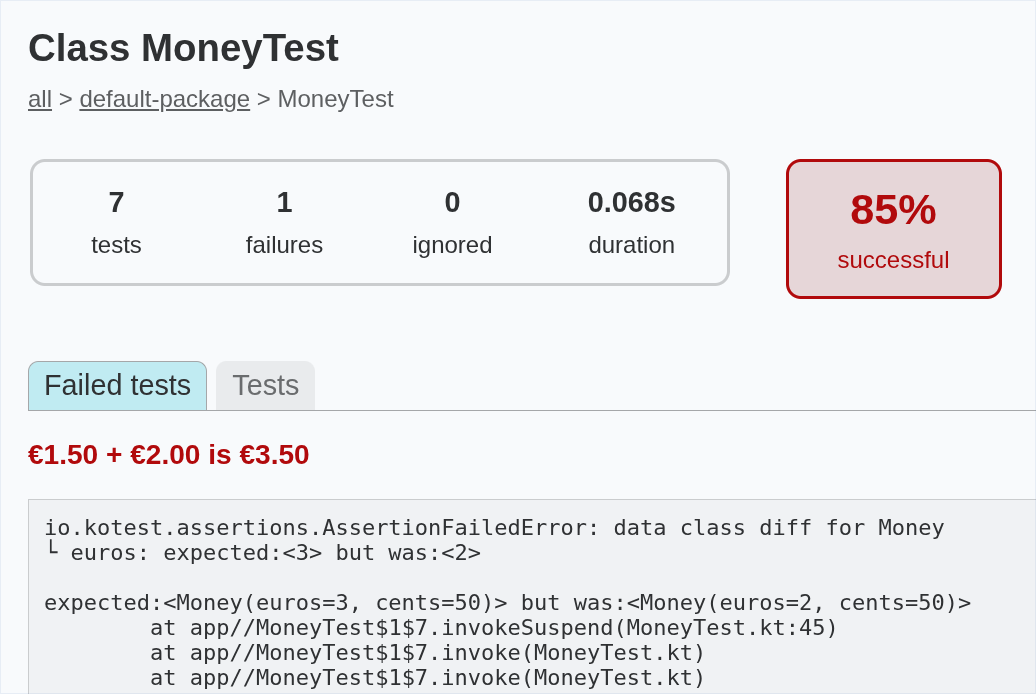
"€1.50 + €2.00 is €3.50" {
    Money(1, 50) + Money(2, 0) shouldBe Money(3, 50)
}
This will fail when executed.
-
The failed test motivates a modification to the implementation of the addition operator, so that it adds the
eurosproperties of the twoMoneyobjects:operator fun plus(other: Money) = Money(euros + other.euros, 50)Make this change and rerun the tests. They should now all pass.
-
Verify that cents are added correctly with a test like this:
"€1.50 + €0.01 is €1.51" {
    Money(1, 50) + Money(0, 1) shouldBe Money(1, 51)
}
This should fail when you rerun the tests.
-
Make the minimal changes necessary for the failing test to pass:
operator fun plus(other: Money) = Money(euros + other.euros, cents + other.cents) -
There is one further aspect of adding together two
Moneyamounts that we need to test. If the sum of thecentsvalues equals or exceeds 100, we need to represent this as an additional euro plus zero or more remaining cents.Add this test to
MoneyTest:"€2.99 + €0.01 is €3.00" { Money(2, 99) + Money(0, 1) shouldBe Money(3, 0) }This should fail when you run the tests.
-
Make the changes to the addition operator that are needed for this final test to pass. We’ll let you figure those out for yourself!
Other Things To Try
You’ve hopefully done enough now to understand the TDD cycle, but if you want to carry on and gain more experience of it, here are a few optional tasks:
- Implement comparisons using the
<,<=,>,>=operators - Override
toString()so that it returns strings like€0.01and€10.50 - Add support for subtraction of one amount of money from another
In each case, be sure to follow a test-driven approach: write a test to verify one aspect of the desired behaviour, make sure it fails, then write the minimum of code needed for the test to pass. Repeat these steps until all aspects of the desired behaviour are covered by tests that pass.
You could also try refactoring the tests—e.g., introducing a test fixture.
Final Thoughts
You may still be unconvinced by TDD. Newcomers to the concept often feel that it is slow and unnecessarily cautious, forcing you to take small steps towards the desired implementation when the nature of that implementation is ‘obvious’—but this is missing the point.
Take a close look at the tests you have written in MoneyTest. Effectively,
these document the required behaviour of the Money class. There are two
tests that document the requirement that euros and cents values are stored
in, and can be retrieved from, a Money object. There are three tests that
document the constraints that are enforced on the values of euros and cents.
There are four tests that collectively encode the rules governing how two
sums of money should be added together. Use of TDD has resulted in the
development of a complete and executable requirements specification for
the Money class. Without using TDD, we might not have arrived at such a
complete specification.
Because the requirements are specified so comprehensively by tests, you can have more confidence in the correctness of your implementation. You can also be more confident about refactoring the class in future development work, knowing that unintended changes in its behaviour will be flagged by failing tests.
Finally, TDD’s emphasis on not implementing more code than is necessary to
make the tests pass means that you haven’t wasted any time over-engineering
the Money class by adding features that aren’t yet needed.
-
Failure to compile counts as a failed test here. ↩