OO Analysis Techniques
Overall Goal
The goal of object-oriented analysis is to come up with a high-level model of the system as a collection of collaborating classes.
The process of identifying objects and classes, and how they relate to each other, is not an exact science. It isn’t necessary to get this right first time; indeed, it is entirely normal to refine an object-oriented model as we learn more about the system and how it is supposed to work.
Object-oriented analysis and design are thus fundamentally iterative in nature, like many aspects of software development.
A number of techniques have emerged for creating a high-level class model of a system. Two of the most popular are noun identification and CRC cards. Typically, these are used in conjunction with each other to analyze a problem domain and come up up with an OO model.
Noun Identification
The starting point for this technique is the text of a particular use case or user story, i.e., a description of something that the software will need to do.
Step 1 is to underline all the nouns and noun phrases in the text. These, reduced to their singular form1, become the initial set of candidate classes.
Step 2 involves discarding candidates that are deemed inappropriate for any reason, and also renaming initial candidates if necessary.
Here are some reasons why we might discard a candidate class:
- Redundant
- Vague
- Attribute of another class
- Event or operation
- Meta-language
- Outside scope of system
Redundancy occurs when you have multiple noun phrases that all refer to the same thing. Pick one noun to use as the name of the class and discard all the others.
Vagueness arises when you can’t tell unambiguously what is meant by a particular noun. You need to clear up that ambiguity before you can say whether the noun should be a class.
An attribute of another class will typically be a noun representing
something that is too simple to be a class itself. For example, a customer’s
name can just be a string attribute of a Customer class; it almost certainly
doesn’t need to be a class itself.2
Some nouns may refer to an event or operation: something that is done to, by, or in the system. Sometimes it is helpful for these things to be classes themselves, but often this is not the case. Ask yourself whether the thing has state, behaviour and identity: if so, it should be represented with a class; if not, it can be discarded.
Meta-language includes nouns that are part of the way that we define things. For example, the text of a use case or user story may use words like ‘feature’ or ‘system’. These are part of the language we use to describe requirements. They should not be classes themselves.
Some nouns represent things that are outside the scope of the system.
For example, in an e-commerce application, we wouldn’t have a class named
Shop, to represent the place from which a customer purchases items.
The classes we choose should generally be things that are inside the system
being modelled.
Example
Consider a university library that offers books and journals on loan to students and members of staff. Here are two paragraphs describing how the loan system should operate, with the nouns & noun phrases underlined:
The library contains books and journals. It may have several copies of a given book. Some of the books are for short term loans only. All other books may be borrowed by any library member for three weeks. Members of the library can normally borrow up to six items at a time, but members of staff may borrow up to twelve items at one time. Only members of staff may borrow journals.
The system must keep track of when books and journals are borrowed and returned, enforcing the rules described above.
The underlined things are the initial candidate classes. From this list, we would discard:
- Library (outside scope of system)
- Short term loan (loans are really events)
- Week (measure of time, not a useful thing)
- Member of the library (redundant: duplicate of ‘library member’)
- Item (vague: really means book or journal)
- Time (outside scope of system)
- System (meta-language)
- Rule (meta-language)
This leaves us with
- Book
- Journal
- Copy (of book)
- Library member
- Member of staff
This is only an initial model, and it may be refined further. For example,
we might later realize that all copies of a book are identical, so it will
be sufficient to just count them and represent this as an attribute of
the Book class.
CRC Cards
CRC cards are a long-established technique for checking and further refining an object-oriented model. The acronym ‘CRC’ stands for “Class, Responsibilities, Collaborations”.
The idea is fairly simple. For each class, you create a ‘card’ with the name of the class at the top. Underneath the name, you list the responsibilities of the class on the left side of the card, and the collaborators of the class on the right side.
The list of responsibilities captures, at a high level, the purpose of the class. They explain what it does, and why it is needed.
The list of collaborators identifies the other classes that help this class fulfil its responsibilities.
CRC cards are traditionally created as physical index cards that can be placed on a large table and rearranged as necessary while a team of developers discusses the design of the system. A variation on this idea uses Post-it notes stuck to a whiteboard, or stuck onto paper sheets that can be mounted on a wall later.
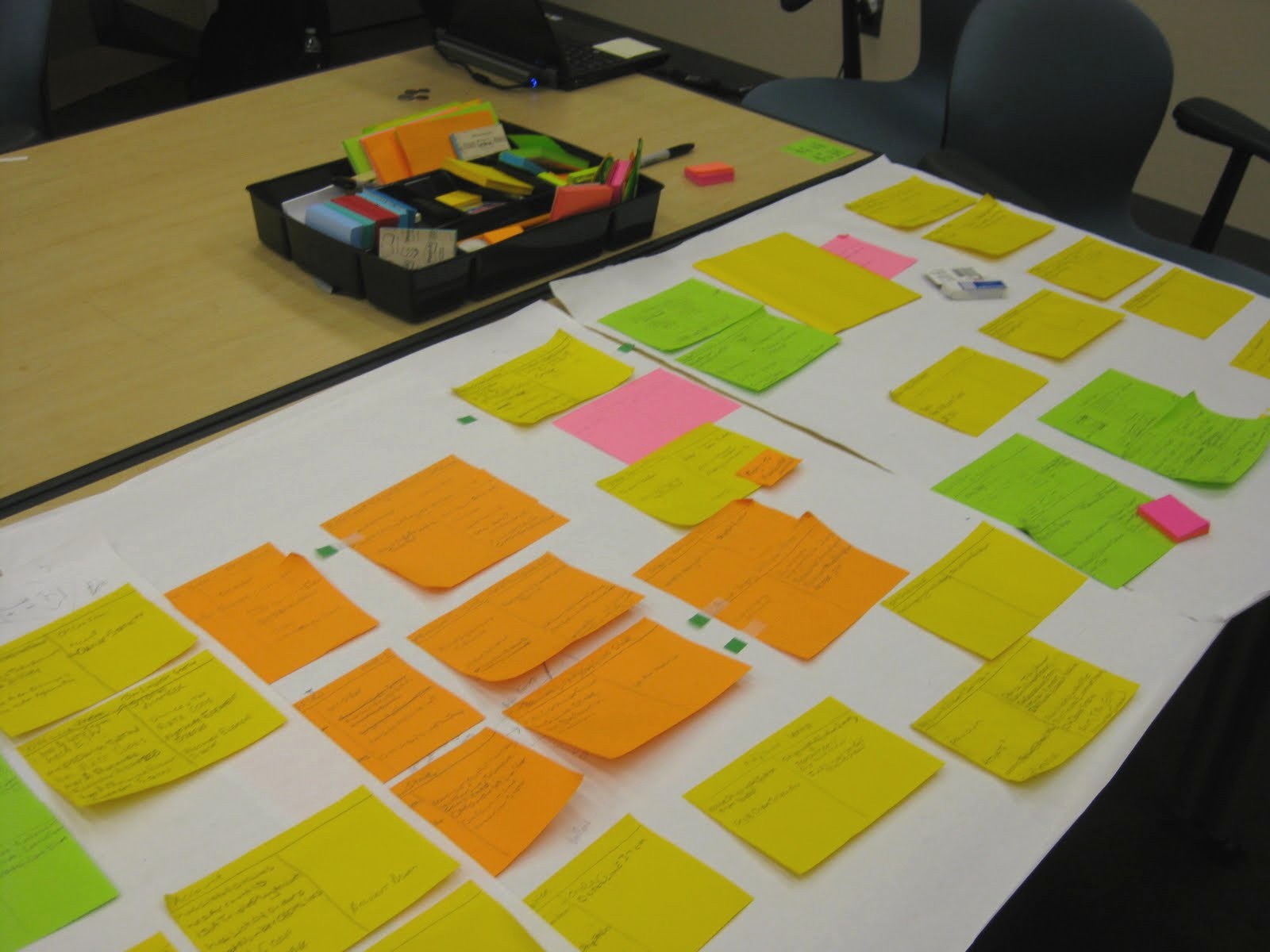
The class name and its responsibilities are written on the note. Collaborators are shown by drawing lines on the whiteboard or the backing paper, linking the note to other notes.
It’s usually easier to identify responsibilities than collaborators at first. The list of collaborators will typically grow as the team discusses the classes and explores how these classes might work in concert with each other.
Too many responsibilities indicates that a class has low cohesion.
Too many collaborators indicates that a class has high coupling.
Systems are easier to develop, test, maintain and extend if they are composed of highly cohesive classes that are loosely coupled with each other.
Example
Let’s consider the classes emerging from the earlier noun identification example.
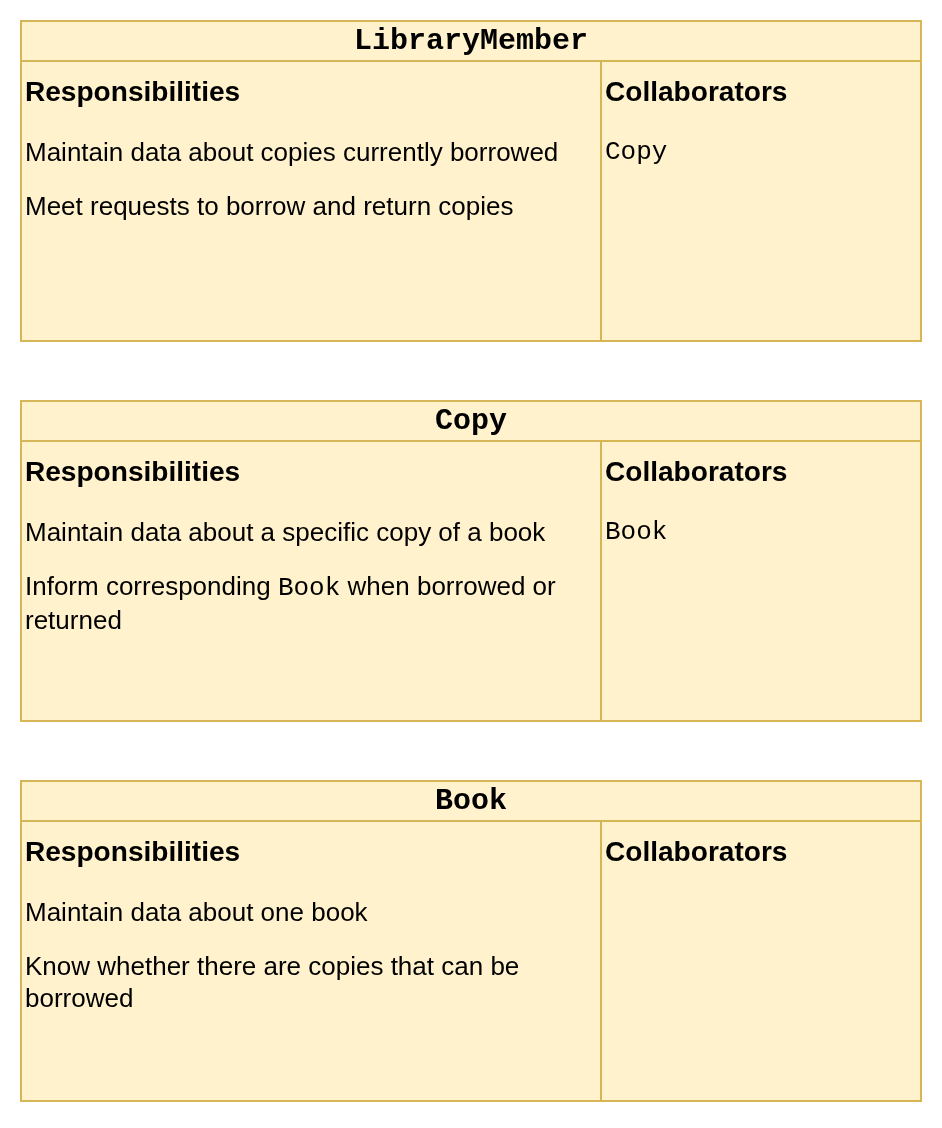
The most important of these classes are LibraryMember, Copy and Book.
The CRC cards for these classes might look like this:
-
A class describes a singular thing. Thus ‘Bank Account’ is a class, but ‘Bank Accounts’ is not. ↩
-
Sometimes it isn’t clear whether something should be represented with a simple data type or a dedicated class. In such situation, pick one option and then refine the design or refactor your code later, when you’ve learned more about the system. ↩